Leishmaniasis in Pakistan: The Skin Disease Nobody Talks About
On February 1, 2022, the deputy commissioner of Dadu confirmed 1,500 active cases of a skin disease that rarely makes headlines, with another 100 to 150 patients arriving at health facilities every single day. The disease was cutaneous leishmaniasis, spread by the bite of a tiny sand fly and the Dadu outbreak was only the most visible part of a much quieter national problem.
Pakistan has recorded more than 27,000 confirmed cases over a decade of surveillance and every case that heals leaves the same thing behind: a permanent scar, often on the face or hands. Yet this skin disease is rarely discussed outside the districts it affects, which is why so many patients reach a doctor late and unsure what they are dealing with.
What Is Leishmaniasis?
Leishmaniasis is a parasitic disease spread by the bite of infected female sand flies. The World Health Organization describes three main forms. The visceral form attacks internal organs and is almost always fatal without treatment. Cutaneous leishmaniasis, the most common form, causes skin ulcers, while the mucocutaneous form affects the mouth, nose and throat. In Pakistan the form that matters most is cutaneous, known in older medical texts as the oriental sore.
It belongs to the group of neglected tropical diseases, conditions that thrive where poverty, weak sanitation and limited access to healthcare overlap. A sore usually begins as a small bump weeks or months after the bite. It slowly grows into an open ulcer and eventually heals on its own, but the process can take many months and often leaves lifelong scars.
The Scale of the Crisis in Pakistan
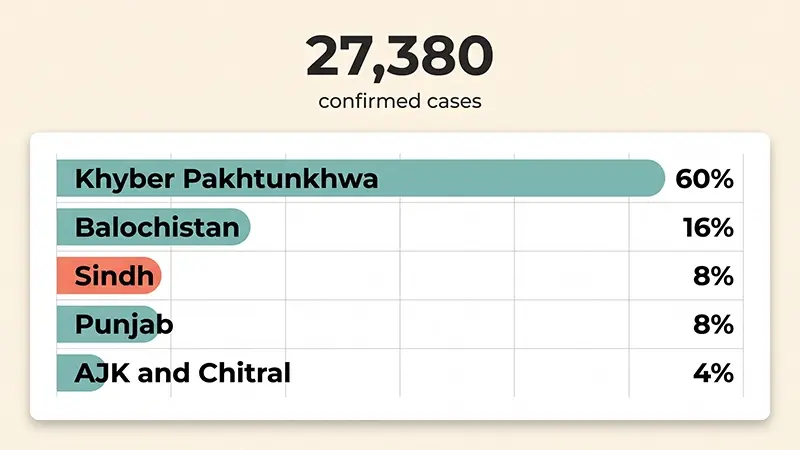
A review of a decade of surveillance data found 27,380 confirmed cases of cutaneous leishmaniasis in Pakistan. Khyber Pakhtunkhwa carried the heaviest burden at 60 percent, followed by Balochistan at 16 percent, Sindh at 8 percent and Punjab at 8 percent. Men accounted for roughly 60 to 65 percent of cases.
The dominant parasite species were Leishmania tropica and Leishmania major. Leishmania tropica mostly passes between people through sand flies and is common in towns, while Leishmania major is carried by rodents and is more common in rural areas. Confirmed cases also only count patients who reached a health facility and were tested, so the true burden is almost certainly higher.
Sindh's Own Outbreak: What Happened in Dadu
Sindh accounts for a smaller share of national cases, but its outbreaks arrive suddenly. In early 2022, Dawn reported that the infection had spread across 13 union councils of the Kachho belt in west Dadu. Unofficial estimates went above 3,000 cases and the taluka hospital in Johi alone recorded around 1,000 patients in a single week.
Men, women and children of every age were among the patients. Local doctors believed sand flies travelling with nomadic families from Balochistan had carried the infection into the area. WHO supplied a consignment of 1,500 glucantime injections to the district health department while new patients were still arriving. A senior dermatologist at Dadu Civil Hospital urged residents to keep their hands, face and feet covered and to avoid affected areas at night.
Why Leishmaniasis Keeps Spreading
No single factor explains why this skin disease keeps finding new communities. Several pressures overlap.
Population Movement into New Areas
Cutaneous leishmaniasis was once confined to a few endemic regions, but migration driven by conflict and instability has carried it into places that never had it. Karachi was historically not an endemic city, yet doctors there now treat patients from Balochistan, Sindh and Khyber Pakhtunkhwa.
Exposed Skin and Night-Time Bites
In a Karachi study of patients, 96.3 percent of lesions appeared on exposed parts of the body such as the face, arms and legs. Sand flies bite mainly in the evening and at night, when farm workers, herders and families sleeping in open courtyards are most at risk.
Low Awareness and Late Diagnosis
Researchers describe high prevalence combined with extremely low awareness in endemic regions as a key reason the disease has spread. Poor health literacy, poverty and limited access to healthcare make it harder still for families to recognize a slow-growing sore as something that needs a doctor.
Cutaneous Leishmaniasis Symptoms: Recognizing the Warning Signs
Cutaneous leishmaniasis develops slowly, which is part of why it is dismissed at home. Signs worth paying attention to include:
- A small red bump on exposed skin, appearing weeks or months after a sand fly bite
- A bump that gradually grows into an open sore or crusted ulcer
- A sore that is often not very painful but refuses to heal over several weeks
- One sore or several, usually on the face, hands, arms or legs
- A depressed scar after the sore finally heals
Any skin sore that does not heal within a few weeks deserves a clinical check, especially for people living in or visiting interior Sindh and the Balochistan border areas.
The Scars Nobody Sees
Because lesions sit on exposed skin, this skin disease is hard to hide. WHO notes that the scars can cause disability and stigma. Published research also describes lasting psychosocial effects, including declining mental health and social exclusion, for patients who live with visible scarring.
That makes early diagnosis a matter of dignity as much as health. A patient who is examined and treated early has a better chance of avoiding the lasting marks that turn a medical condition into a social burden.
Diagnosis and Treatment
Doctors usually suspect the disease from the appearance of the sore and where the patient lives and the laboratory confirms it with a stained skin smear or culture. WHO also notes that untreated lesions remain a source of infection for sand flies for a few months and sometimes up to two years, so treating one patient also protects the neighbors.
Treatment depends on the parasite species and on how many lesions there are and where they sit. Some patients receive intralesional injections into or around the sore, sometimes combined with cryotherapy, which freezes the lesion. Others need injectable medicines such as glucantime (meglumine antimoniate), the drug WHO supplied during the Dadu outbreak. Treatment should always be supervised by a qualified doctor rather than managed with home remedies.
Preventing Leishmaniasis: What Families Can Do
There is no vaccine for humans, so the only reliable way to prevent leishmaniasis is to avoid sand fly bites.
Cover Up at Dusk and Night
Protecting skin during the hours when sand flies are active is the simplest step. Long sleeves, trousers and covered feet reduce exposure and insect repellent on exposed skin adds another layer.
Sleep Under Fine-Mesh Nets
Sand flies are much smaller than mosquitoes and pass through ordinary nets. Fine-mesh, insecticide-treated nets give families sleeping in rooms or courtyards a real layer of protection.
Report Sores Early and Support Community Spraying
Families who get a non-healing sore checked early protect both themselves and their neighbors. The Dadu dermatologist also called for fumigation across every affected union council, a reminder that individual precautions work best alongside community-level vector control.
How SHINE Humanity Supports Early Detection in Rural Sindh
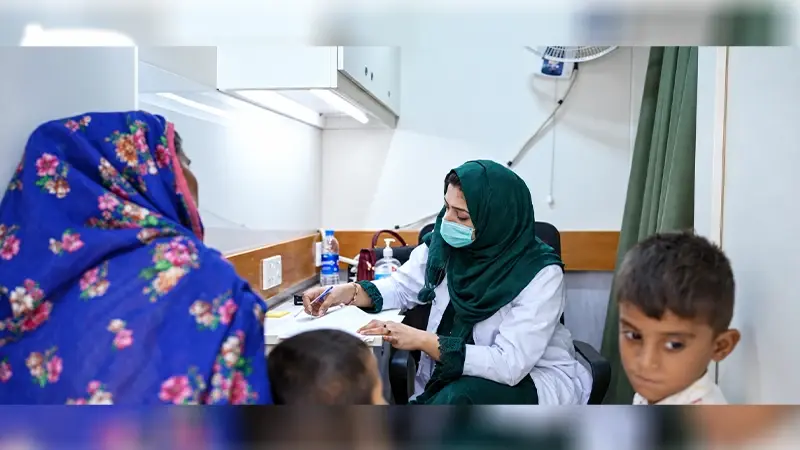
SHINE Humanity's free primary healthcare clinics across rural Sindh give families a first point of contact, where a persistent sore can be examined and referred onward. Community outreach teams carry health education to the household level, while Mobile Urgent Care Units bring doctors to villages with no care nearby.
SHINE was also the first rural healthcare organization in Pakistan to digitize its medical records, so a doctor can look back at earlier visits and see whether a slow-growing lesion is healing or spreading. Its telemedicine work connects patients with physicians without a long journey. This includes a collaboration with Sehat Kahani in Tando Hyder that has averaged around 600 patients a month.
None of this replaces specialist treatment, but it shortens the distance between a family's first sore and a patient's first consultation.
Conclusion
Leishmaniasis in Pakistan is treatable, and WHO is clear that early diagnosis and prompt treatment reduce its spread and prevent disability. Delay has a cost. Every month a sore goes unchecked means a larger scar for the patient and more sand flies infected around the home.
For families in rural Sindh, protection starts with someone who recognizes a sore that will not heal and knows where to send it.
Support SHINE Humanity's mission to bring early diagnosis and primary healthcare to rural communities across Sindh.
Frequently Asked Questions
1. What causes leishmaniasis?
Leishmaniasis is caused by Leishmania parasites, which pass to humans through the bite of infected female sand flies.
2. Is leishmaniasis contagious?
No, it does not spread through touch, shared food or living near a patient, only through the bite of an infected sand fly.
3. Can leishmaniasis be fatal?
The cutaneous form common in Pakistan is not life-threatening, but the visceral form, which attacks internal organs, is almost always fatal without treatment.
4. Which parts of Pakistan are most affected?
A decade of surveillance data shows Khyber Pakhtunkhwa carries 60 percent of confirmed cases, followed by Balochistan at 16 percent and Sindh at 8 percent. Sindh has also seen sudden outbreaks, such as the one in Dadu in 2022.
5. Does cutaneous leishmaniasis heal without treatment?
Some sores heal on their own over many months, but they usually leave a scar and can keep infecting sand flies, so any sore that does not heal should be checked by a doctor.
6. How can families prevent leishmaniasis?
Covering skin at dusk and night, using insect repellent, sleeping under fine-mesh insecticide-treated nets and supporting community spraying all reduce exposure to sand fly bites.